For centuries, clothing has been a form of expression. What we wear reveals our tastes, cultures, professions, and personalities. But in the decades ahead, our clothes may do something entirely new.
They may understand us.
From smart watches that monitor heart rates to rings that track sleep patterns, wearable technology is already becoming a part of everyday life. The next frontier, however, is far more intimate: intelligent clothing.
What happens when the fabric itself begins to sense, learn, and respond?
The Rise of Intelligent Garments
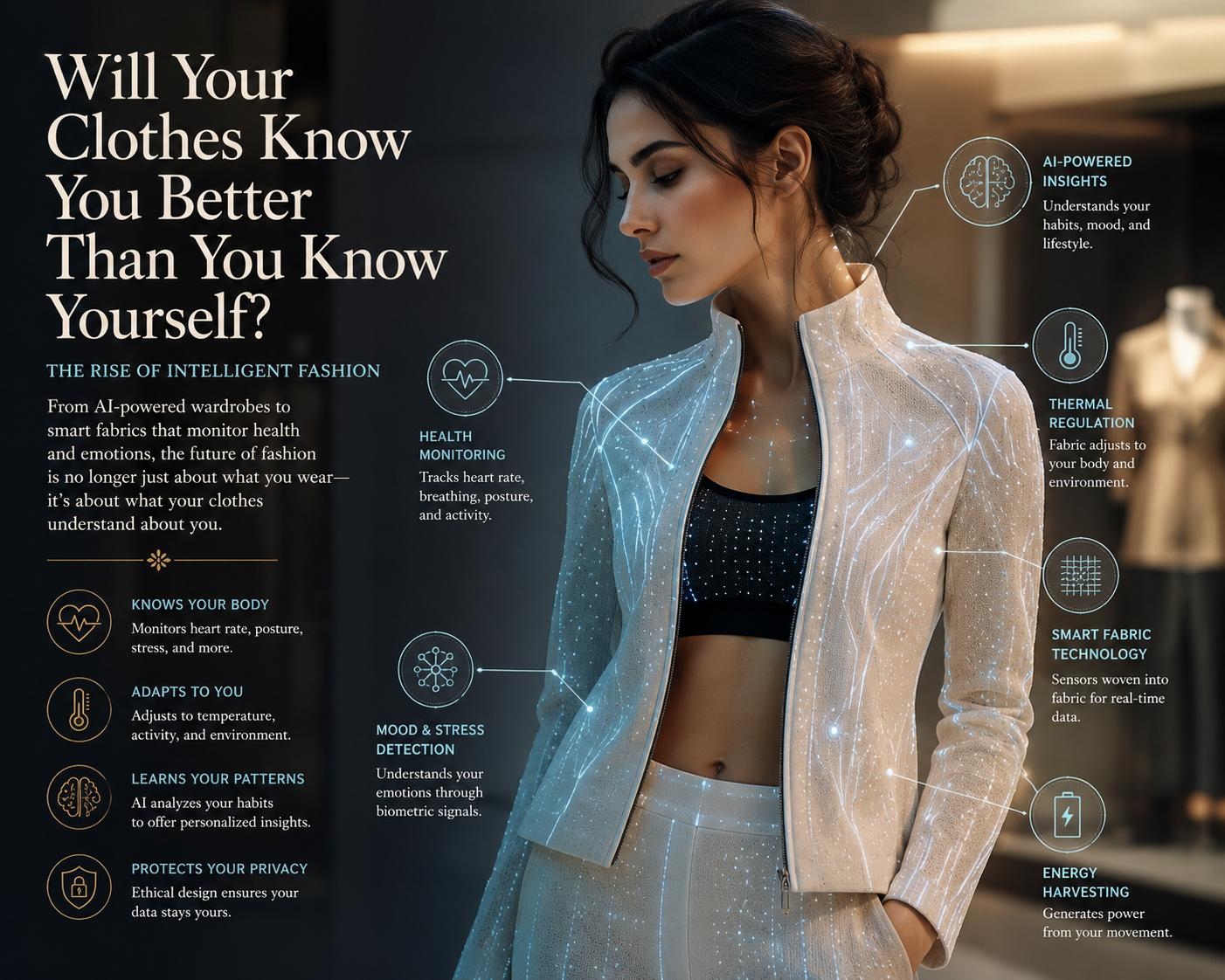
Scientists and designers are developing textiles embedded with sensors capable of measuring temperature, heart rate, stress levels, hydration, posture, and movement.
A shirt may one day alert you to irregular breathing.
A jacket could adjust its insulation based on the weather.
Athletic wear may monitor fatigue and recommend when it’s time to rest.
What once belonged to science fiction is slowly entering reality.
But these technologies raise an intriguing question: could our clothes understand our bodies—and perhaps our habits—better than we do ourselves?
Fashion Meets Artificial Intelligence
Artificial intelligence thrives on patterns.
It studies what we buy, what we wear, how we move, and even the colors we prefer. Combined with smart textiles, AI may enable clothing to adapt to our lifestyles in ways previously unimaginable.
Imagine opening your wardrobe in the morning and receiving suggestions based on the weather, your schedule, and even your mood.
Your suit might recommend itself for an important meeting.
Your exercise apparel could remind you that your body hasn’t fully recovered from yesterday’s workout.
Your clothes may become less passive and more like companions.
Emotional Fashion
Researchers are exploring materials that react to heat, light, and movement. In the future, wearable technologies may even detect emotional states through physiological signals.
Stress, anxiety, and excitement all leave traces on the body.
Clothing capable of sensing these changes could help people manage their health or simply become more aware of themselves.
Imagine garments that suggest relaxation when stress levels rise or fabrics that adjust to improve comfort throughout the day.
Fashion may evolve from decoration to interaction.
A Mirror of Human Behavior
For decades, social media platforms have known our preferences through clicks and searches.
Tomorrow, intelligent fabrics may learn from our daily rhythms.
How long do we sleep?
When do we exercise?
Which environments make us uncomfortable?
How often do we travel?
Over time, our clothing may become a living record of our lifestyles.
The wardrobe of the future might not simply contain memories—it might understand them.
The Privacy Question
Yet with great intelligence comes great responsibility.
Who owns the data generated by our clothes?
Will our garments communicate with healthcare providers, insurance companies, or digital assistants?
Can intimate information about our bodies and emotions remain private?
As fashion enters the age of artificial intelligence, ethics may become just as important as aesthetics.
The future of clothing will not only be designed by engineers and designers but also by philosophers, lawmakers, and society itself.
From Fabric to Companion
Throughout history, clothing has evolved alongside civilization.
Animal skins became woven textiles.
Handcrafted garments gave way to industrial production.
Today, sustainability and technology are reshaping the industry once again.
Perhaps the next transformation will be even more profound.
Clothing may no longer be something we simply wear.
It may become something that understands us.
Not because it possesses consciousness, but because it continuously learns from our habits, health, and experiences.
And in that future, a curious possibility emerges.
The wardrobe hanging quietly in our closets may know things about us that we overlook ourselves.
Not just our size or our favorite color.
But how we sleep.
How we move.
How we feel.
And perhaps, who we are becoming.
Because the future of fashion may not lie merely in beauty.
It may lie in understanding.